
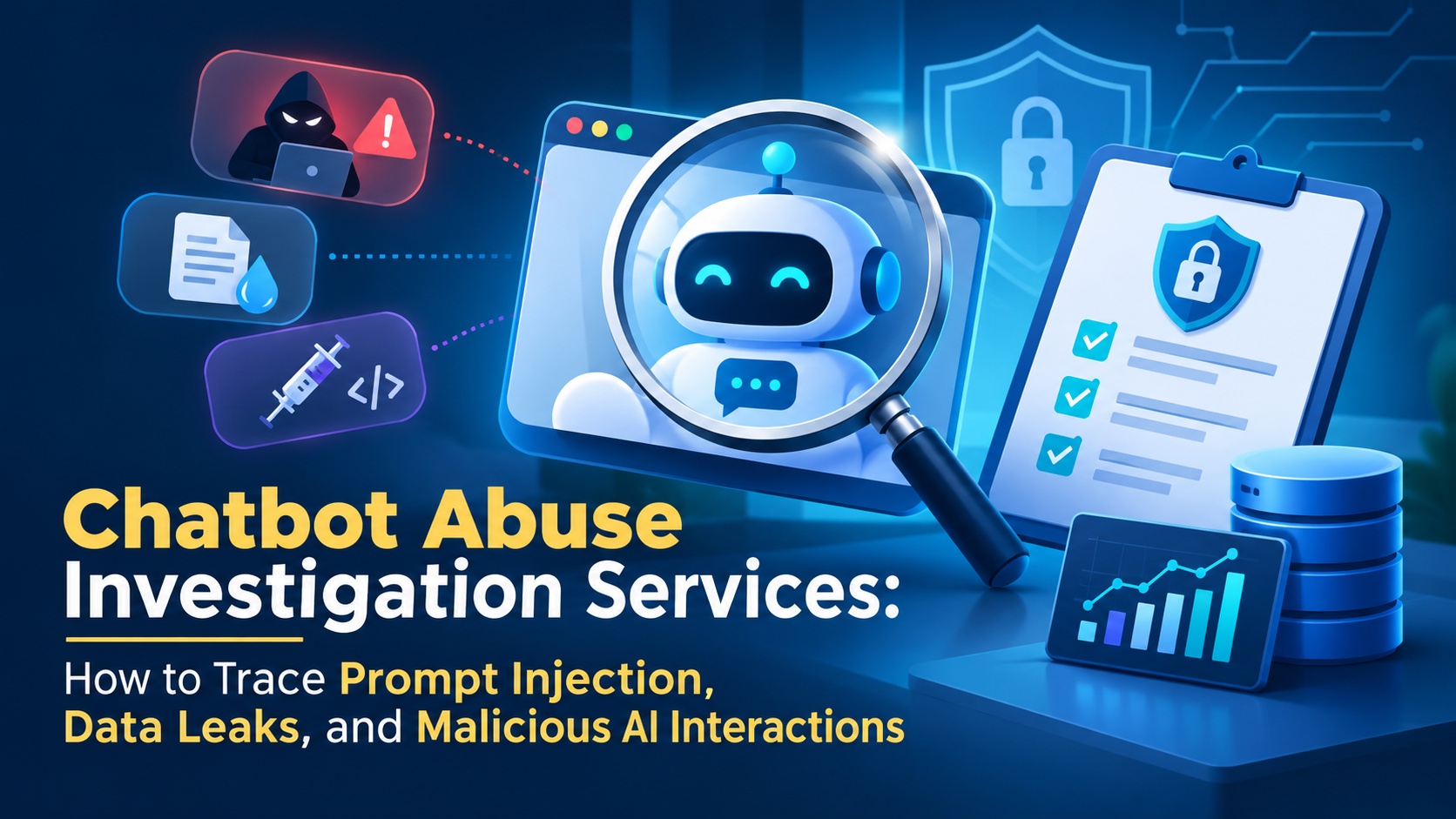
AI chatbots now support customer service, knowledge searches, sales, and operations. Yet every conversation can become an attack surface. A crafted prompt may bypass safeguards, expose confidential information, or manipulate a system into unauthorised actions. Chatbot Abuse Investigation services help organisations identify such threats, trace malicious interactions, and understand how their AI systems may have been compromised. Investigating incidents requires more than reading transcripts: it means examining prompts, model behaviour, connected tools, and data flows.
Why chatbot abuse needs specialist investigation
Unlike conventional attacks, chatbot abuse often exploits how a model interprets instructions and context. Attackers may hide commands in messages, uploaded documents, websites or retrieved content. They may probe restrictions, extract sensitive responses or misuse connected services.
Chatbot Abuse Investigation services help establish what happened, how an interaction succeeded, what information or systems were affected, and whether activity continues. The aim is to establish facts, preserve evidence, and limit exposure.
Tracing prompt injection and malicious interactions
Prompt injection occurs when untrusted content attempts to override a chatbot’s intended instructions. Direct attacks appear in user prompts; indirect attacks may be embedded in files, emails, webpages, or knowledge-base material.
Investigators reconstruct interactions using conversation logs, timestamps, session identifiers, application events, retrieval records, and tool-call histories. They examine suspicious instructions, repeated attempts, and differences between expected and actual behaviour. Controlled testing can help reproduce weaknesses without exposing live data.
Identifying data leaks and unauthorised access
A chatbot may disclose information because access controls are weak, retrieval sources are misconfigured, histories are exposed, or sensitive data enters prompts. Investigators identify what was requested and returned, trace its source, and establish whether an unauthorised person accessed it.
The review should cover connected databases, APIs, plugins, cloud services and identity permissions. It must distinguish confirmed disclosure from attempted extraction: a suspicious prompt alone does not prove a leak.
Frequently Asked Questions
- What is prompt injection?
It manipulates an AI system through instructions that conflict with its intended rules and safeguards.
- Can investigations identify leaked data?
Yes. Investigators trace responses to sources, review access records and determine whether information was disclosed.
- Are chatbot logs enough to prove abuse?
No. Investigators correlate logs with application events, identity records and connected-tool activity for reliable conclusions.
- When should a business investigate suspicious chatbot activity?
Investigate unusual disclosures, repeated safeguard bypasses, unexpected tool actions or credible misuse reports promptly and thoroughly.
- How can organisations reduce future chatbot abuse?
Use least-privilege access, test prompts regularly, isolate sensitive data and monitor model and tool activity.
How Chatbot Abuse Investigation services protect your AI environment
Effective Chatbot Abuse Investigation services combine digital forensics, application security, and AI-specific testing. Investigators secure logs and system snapshots, map the chatbot’s architecture, correlate events, assess impact, and document findings. They recommend controls: stricter permissions, safer retrieval boundaries, input and output filtering, secret management, rate limits, human approval for sensitive actions, and continuous monitoring.
Organisations should retain logs while protecting personal information, restricting access, and following retention requirements. Evidence handling should be documented to support remediation, governance, or incident response.